
The Derivative
1. Motivation
Many quantities in mathematical biology change continuously — population density, drug concentration, resistant fraction — and we frequently want to know not just how much a quantity has changed, but how fast it is changing at a given instant.
Consider a function $y = f(x)$. Over an interval from $x$ to $x + \Delta x$, the quantity changes by
\[\Delta y = f(x + \Delta x) - f(x).\]The average rate of change over this interval is the ratio
\[\frac{\Delta y}{\Delta x} = \frac{f(x + \Delta x) - f(x)}{\Delta x},\]which is exactly the slope of the straight line (the secant) joining the two points $(x, f(x))$ and $(x + \Delta x, f(x + \Delta x))$ on the curve.
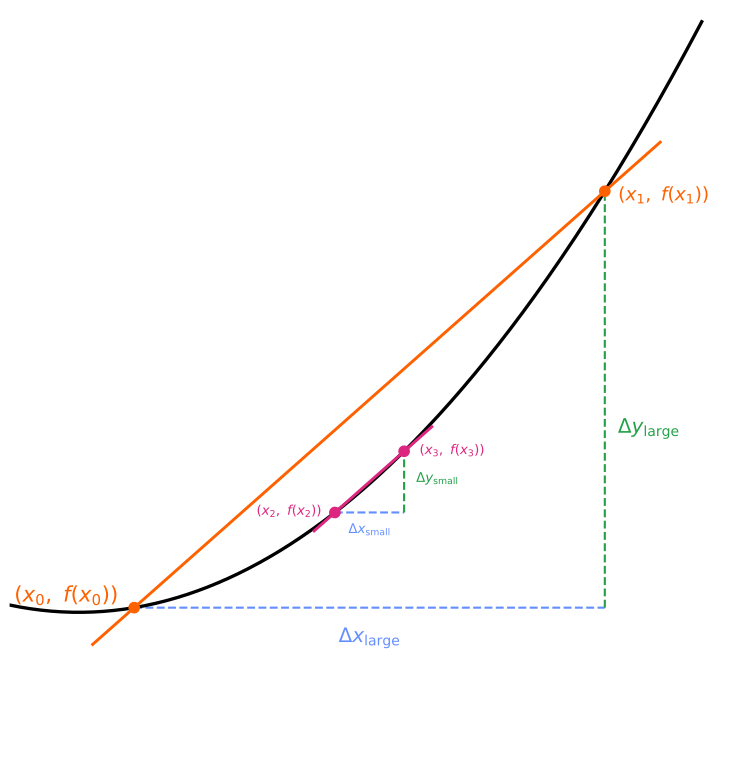
The orange secant line spans a wide interval, $\Delta x_{\text{large}}$ (marked in blue), giving only a rough approximation to the rate of change at the midpoint of $x_0$ and $x_1$. The pink secant line, centred within the same span, uses a much narrower $\Delta x_{\text{small}}$: its slope sits closer to the true instantaneous rate. In both cases, the corresponding rise is marked in green as $\Delta y$.
As the interval shrinks further, the pink secant converges toward the tangent line at $x_0$, and the ratio $\Delta y / \Delta x$ converges toward the derivative $f'(x_0)$ — the limiting process stated formally in Definition 1.1.
This average rate depends on the size of $\Delta x$ chosen — a wide interval can smooth over rapid local behaviour a narrower one would capture. To recover the instantaneous rate of change at the single point $x$, we shrink the interval, letting $\Delta x \to 0$. As this happens, the secant line rotates and settles into the tangent line at $x$, and the ratio $\Delta y / \Delta x$ settles into a single limiting value — the derivative:
\[\frac{dy}{dx} = \lim_{\Delta x \to 0} \frac{\Delta y}{\Delta x}.\]This is the same object introduced formally in Definition 1.1 below, with $h$ used in place of $\Delta x$ — the notation $dy/dx$ (due to Leibniz) emphasises this limiting process explicitly, treating $dy$ and $dx$ as infinitesimal versions of $\Delta y$ and $\Delta x$.
2. Definition
Intuitively, the derivative asks: if I nudge $x$ by a tiny amount, how much does $f(x)$ change, per unit of nudge? Definition 1.1 makes this precise by taking that nudge, $h$, to zero.
Definition 1.1 (Derivative) Let $f: \mathbb{R} \to \mathbb{R}$. The derivative of $f$ at $x$ is
\[\begin{equation} f'(x) = \lim_{h \to 0} \frac{f(x+h) - f(x)}{h} \label{eq:derivative-def} \end{equation}\]provided this limit exists. If it does, $f$ is said to be differentiable at $x$.
Quick numeric check
For $f(x) = x^2$ at $x=2$: taking $h = 0.1, 0.01, 0.001$ gives $\frac{f(2+h)-f(2)}{h} = 4.1, 4.01, 4.001$ — approaching $4$, matching $f’(2)=4$ from the power rule.
Remark Common notations for the derivative include $f’(x)$, $\dfrac{df}{dx}$, $\dfrac{dy}{dx}$ (if $y = f(x)$), and $\dot{f}$ (typically reserved for derivatives with respect to time).
3. Geometric interpretation
The quotient in \eqref{eq:derivative-def} is the slope of the secant line through $(x, f(x))$ and $(x+h, f(x+h))$. As $h \to 0$, the secant line converges to the tangent line at $x$, and $f’(x)$ is precisely that tangent’s slope.
Remark: when differentiability fails The limit in \eqref{eq:derivative-def} must give the same value whether $h \to 0$ from above or below. At a sharp corner (e.g. $f(x) = |x|$ at $x=0$), the left and right limits disagree, so no single tangent slope exists — $f$ is continuous there but not differentiable.
4. Basic differentiation rules
Theorem 1.2 (Linearity)
\[\begin{equation} \frac{d}{dx}\left[a f(x) + b g(x)\right] = a f'(x) + b g'(x) \label{eq:linearity} \end{equation}\]Scaling or adding functions scales or adds their derivatives — differentiation doesn’t “mix” terms together.
Theorem 1.3 (Product Rule)
\[\begin{equation} \frac{d}{dx}\left[f(x)g(x)\right] = f'(x)g(x) + f(x)g'(x) \label{eq:product-rule} \end{equation}\]Each factor is differentiated in turn, with the other held fixed — you can’t simply multiply $f’(x)$ and $g’(x)$ together.
Theorem 1.4 (Quotient Rule)
\[\begin{equation} \frac{d}{dx}\left[\frac{f(x)}{g(x)}\right] = \frac{f'(x)g(x) - f(x)g'(x)}{g(x)^2}, \quad g(x) \neq 0 \label{eq:quotient-rule} \end{equation}\]This is a special case of the product rule applied to $f(x)\cdot g(x)^{-1}$; the $g(x)^2$ in the denominator comes from differentiating that inverse.
Theorem 1.5 (Chain Rule)
\[\begin{equation} h'(x) = f'(g(x)) \, g'(x), \quad \text{where } h(x) = f(g(x)) \label{eq:chain-rule} \end{equation}\]For a composition of functions, rates of change compound: multiply the outer function’s derivative (evaluated at the inner function) by the inner function’s own derivative.
Remark All rules stated here extend naturally to compositions — e.g. combining the chain rule with the standard derivatives table lets you differentiate expressions like $e^{\sin x}$ or $\ln(x^2 + 1)$ without returning to first principles each time.
5. Standard derivatives
Theorem 1.6 (Power Rule)
\[\begin{equation} f'(x) = n x^{n-1}, \quad f(x) = x^n,\ n \in \mathbb{R} \label{eq:power-rule} \end{equation}\]Includes constants ($n=0$), reciprocals ($n=-1$), and roots ($n=\tfrac{1}{2}$) as special cases.
Remark Theorem 1.6 covers several familiar cases as $n$ varies: a constant $f(x) = c = c \cdot x^0$ gives $f’(x) = 0$; a negative power such as $f(x) = x^{-1} = \tfrac{1}{x}$ gives $f’(x) = -x^{-2} = -\tfrac{1}{x^2}$; and a fractional power such as $f(x) = x^{1/2} = \sqrt{x}$ gives $f’(x) = \tfrac{1}{2}x^{-1/2} = \tfrac{1}{2\sqrt{x}}$.
Theorem 1.7 (Exponential Derivatives)
\[\frac{d}{dx}e^{kx} = k e^{kx}, \qquad \frac{d}{dx}a^x = a^x \ln a, \quad a > 0\]Both follow from the chain rule: for $e^{kx}$, the outer function $e^{(\cdot)}$ is its own derivative, so only the inner factor $k$ is picked up. For $a^x$, rewriting as $e^{x \ln a}$ reduces it to the same case with $k = \ln a$.
Theorem 1.8 (Logarithmic Derivative)
\[\frac{d}{dx}\ln(kx) = \frac{1}{x}, \quad k > 0\]Although $k$ appears inside the logarithm, it cancels: $\ln(kx) = \ln k + \ln x$, and $\ln k$ is a constant with zero derivative — so the result doesn’t actually depend on $k$.
Theorem 1.9 (Trigonometric Derivatives)
\[\frac{d}{dx}\sin(kx) = k\cos(kx), \qquad \frac{d}{dx}\cos(kx) = -k\sin(kx), \qquad \frac{d}{dx}\tan(kx) = k\sec^2(kx)\]As with $e^{kx}$, each is the base derivative (of $\sin x$, $\cos x$, $\tan x$) with an extra factor of $k$ from the chain rule, since the inner function $kx$ has derivative $k$.
6. Worked examples
Example 1.7 Let $f(x) = x^3$. By \eqref{eq:power-rule}, $f’(x) = 3x^2$.
Show derivation from first principles
$$ f'(x) = \lim_{h \to 0} \frac{(x+h)^3 - x^3}{h} = \lim_{h \to 0} \frac{3x^2 h + 3xh^2 + h^3}{h} = \lim_{h \to 0} \left(3x^2 + 3xh + h^2\right) = 3x^2 $$Example 1.8 Let $f(x) = x^2 \sin x$. By the product rule \eqref{eq:product-rule},
\[f'(x) = 2x \sin x + x^2 \cos x\]Show step-by-step application
Identify $u(x) = x^2$, $v(x) = \sin x$, so $u'(x) = 2x$, $v'(x) = \cos x$. Substituting into \eqref{eq:product-rule} gives $f'(x) = u'v + uv' = 2x\sin x + x^2 \cos x$ directly.Example 1.9 Let $f(x) = \sin(x^2)$. By the chain rule \eqref{eq:chain-rule} with outer function $\sin(\cdot)$ and inner function $x^2$,
\[f'(x) = \cos(x^2) \cdot 2x\]